
Hi Everyone!
I wanted to do a blog post on shin splints as I am starting to run more myself and training some clients of mine for 5k and half marathons and I am feeling pain in my shins and I just moan to the boyfriend saying I have shin splints – hoping I will get sympathy and a massage! 🙂
Obviously I have heard of shin splints but never actually knew what they really are. So I thought this would be a good little intuitive read to get an understanding about them.
Hope you guys that run for fun, leisure or training for an event find this useful.
WHAT ARE THEY?
Shin splints are below the knee either on the front outside (anterior) part of the leg or the inside (medial) of the leg – the shin, obviously 🙂
They are a nuisance for many athletes, runners, tennis players etc.
Shin splints occur in beginning runners who do not build their distance gradually enough or seasoned runners who change their workout regime all of a sudden or switching from running on flat surfaces to hills.
The nature of shin splints which is also known as medial tibial stress syndrome (MTSS), is a lot of the time summed up as doing too much too soon!

HOW DO YOU KNOW IF IT IS SHIN SPLINTS?
Having shin pain doesn’t always mean you have shin splints.
It might be a sign of some other problem. There are two conditions that are sometimes mistakenly diagnosed as shin splints.
Pain on the anterior (outside) part of the lower leg may be compartment syndrome—a swelling of muscles within a closed compartment, which creates pressure. To diagnose this condition, special techniques are used to measure the amount of pressure. Sometimes surgical “decompression” is required. The symptoms of compartment syndrome include leg pain, unusual nerve sensations, and eventually muscle weakness.
Pain in the lower leg could also be a stress fracture (an incomplete crack in the bone), which is a far more serious injury than shin splints. A bone scan is the definitive tool for diagnosing a stress fracture. However, there are clues you can look for that will signal whether or not you should get a bone scan.
According to reports the pain of shin splints is also more generalized than that of a stress fracture. If you press your fingertips along your shin, and if you find a definite spot of sharp pain, it’s a sign of a stress fracture.
Additionally, stress fractures often feel better in the morning because the bone has rested all night; shin splints often feel worse in the morning because the soft tissue tightens overnight. Shin splints are also at their most painful when you forcibly try to lift your foot up at the ankle and flex your foot.
WHAT CAN CAUSE SHIN SPLINTS?
Many things can cause shin splints like inadequate stretching; worn down shoes, more stress placed on one leg or hip from running in the same direction on a track or jogging on sloping roads and paths.
Typically one leg gets aggravated, normally the dominant one so if you are right handed you are normally right footed too, which would then be the leg that gets affected and feel pain.
The most common site for shin splints is the medial area (the inside of the shin). Anterior shin splints (toward the outside of the leg) usually result from an imbalance between the calf muscles and the muscles in the front of your leg, and often affect beginners who have not yet adjusted to the stresses of running or are not stretching enough.
But still the question is – What exactly is a shin splint?
There is no end-all consensus among sports scientists apparently, and theories have included small tears in the muscle that has pulled off the bone, an inflammation of the periosteum [a thin sheath of tissue that wraps around the tibia, or shin bone], an inflammation of the muscle, or some combination of these.
Fortunately, experts agree on how to treat them….
HOW TO TREAT SHIN SPLINTS
Experts agree that when shin splints strike you should stop running completely or decrease your training depending on the extent and duration of pain.
1) Ice on the shin area to reduce inflammation.
2) Gently stretch your Achilles, also stretch your shins- Kneel on a carpeted floor, legs and feet together and toes pointed directly back. Then slowly sit back onto your calves and heels, pushing your ankles into the floor until you feel tension in the muscles of your shin. Hold for 10 to 12 seconds, relax and repeat.
3) In a sitting position, trace the alphabet on the floor with your toes, both legs.
4) Alternate walking on your heels for 30 seconds with 30 seconds of regular walking, do this four times.
These exercises are good for both recovery and prevention.
Try to do them three times a day.
5) If you continue running, wrap your leg before you go out.
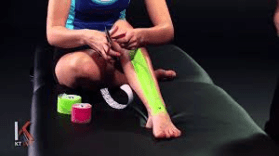
Use either KT tape or an Ace bandage, starting just above the ankle and continuing to just below the knee.
Keep wrapping your leg until the pain goes away, which usually takes three to six weeks.
6) Consider cross-training for a while to let your shin heal.
Swim, run in the pool or ride a bike.
7) When you return to running, increase your mileage slowly, no more than 10 percent weekly.
8) Make sure you wear the correct running shoes for your foot type specifically, over pronators should wear motion-control shoes. Severe over pronators may need orthotics.
Have two pairs of shoes and alternate wearing them to vary the stresses on your legs.
9) Avoid hills and excessively hard surfaces until shin pain goes away completely, then re-introduce them gradually to prevent a recurrence.
10) If you frequently run on roads with an obvious bend and slopes, run out and back on the same side of the road. Likewise, when running on a track, switch directions.
11) If you are prone to developing shin splints, stretch your calves and Achilles regularly as a preventive measure.
I hope you guys enjoyed reading this post and have learnt a little more about shin splints like I have. I will still be trying to get the sympathy from the boyfriend!!
Thank you for reading!
Love
Body By Hollye
XXX
All Enquiries on Personal Training and Programmes:
hollyewalkerfitness@yahoo.co.uk


 Body By Hollye